
Here is an important leadership principle:
Leadership is measured by effectiveness, not by productivity.
Productivity tells us how much work was accomplished. Effectiveness tells us whether our leadership produced the right results, developed the right people, and strengthened the organization for what comes next.
There is an important difference.
Doing Things Right vs. Doing the Right Things
To understand this principle, we must first distinguish between effectiveness and efficiency.
Peter Drucker famously distinguished the two this way: efficiency is concerned with doing things right, while effectiveness is concerned with doing the right things.
An organization can become extremely efficient at activities that ultimately do not matter.
The same distinction can be applied to leadership and management. Management makes sure things are done right. Leadership makes sure the right things are being done.
Too often, leaders spend a disproportionate amount of time managing others while neglecting their responsibility to lead them. Leaders must focus first on effective leadership and trust productivity to become a by-product of that leadership.
Here is another way of saying it:
Productivity measures how much gets done. Effectiveness measures whether what gets done really matters.
Consider seven distinctions between productive leadership and effective leadership.
1. Productivity Measures Activity. Effectiveness Measures Impact.
Productivity usually asks questions such as:
- How much did we accomplish?
- How quickly did we accomplish it?
- How many units did we produce?
- How many meetings did we hold?
- How many tasks did we complete?
Effectiveness asks a different question:
Did our efforts produce the outcome we actually needed?
A leader can oversee a highly productive organization that is moving rapidly in the wrong direction. How often are unnecessary things being done with great efficiency?
Productivity is about output.
Effectiveness is about outcome.
That distinction matters because activity can easily be mistaken for accomplishment. A full calendar, a long task list, and an exhausted workforce may demonstrate productivity, but none of those things necessarily demonstrate effective leadership.
2. Leaders Should Be Measured by What Happens When They Empower Others
Leadership isn’t ultimately measured by how busy the leader is. It is measured by what happens because of the leader’s influence.
When people approach you, do they begin by saying, “I know how busy you are,” or “I’m sorry to interrupt your busy day”?
Is that what you want them to believe about you – that you are so busy you don’t have time to address an important question?
You may, in fact, be very busy. But do you want people to believe you are too busy? And if they do, how can you change that perception?
Perhaps you have worked for a leader who demands to know everything yet seems too busy to be bothered by anything. Inevitably, people stop moving because they cannot get the leader’s time, attention, oversight, or approval.
Productivity declines.
Ironically, the leader then becomes even busier because of ineffective leadership.
Effective leadership creates an environment of empowerment.
Ask yourself:
- Does the team make better decisions?
- Can they solve problems without constantly needing the leader?
- Do they accomplish the mission?
- Can they adapt when circumstances change?
- Are stronger people being developed?
- Are trust and accountability increasing?
- Can the team perform sustainably?
Ultimately:
The measure of leadership is not what the leader produces, but what the leader enables others to produce.
3. Productivity Can Sometimes Disguise Ineffective Leadership
Some leaders are extraordinarily productive.
They answer every email.
They attend every meeting.
They solve every problem.
They make every decision.
They work longer hours than everyone else.
And yet they may be poor leaders.
Why?
Because their productivity can create organizational dependency.
I learned this lesson firsthand.
For years, I worked in law enforcement on a team of surveillance specialists. We were our department’s experts in static, mobile, and technical surveillance. Whenever our organization needed someone found and followed, we were called in.
Each member of our team brought unique skills to the mission, and operational success depended upon our ability to make critical decisions under pressure.
For example, we had to positively identify every suspect before calling in a tactical team to make an arrest. We had to be right 100 percent of the time because that tactical team would bring the level of force necessary to make the apprehension.
Sometimes that meant serving search warrants at residences. Other times, it meant a rapid vehicle intervention on a busy street.
We not only needed to be right; we needed to be confident that we were right.
Personnel changes on our squad were rare because it took years to develop a detective capable of doing this kind of work.
Then we received a new supervisor.
He had no experience in our line of work and believed his role as a leader was to make every important decision. From his perspective, we were making decisions beyond our authority.
Our team objected to the new directive. We understood that waiting for him to make decisions based on information he did not yet have could compromise our covert position, create dangerous delays, and cost us opportunities to make arrests.
But he was the supervisor, so we adjusted.
It made our job almost impossible.
He questioned our ability to identify suspects accurately and often wanted second and third opinions. That meant bringing additional detectives close enough to make an identification. But in surveillance work, every additional vehicle and every additional person creates another opportunity to compromise the investigation.
His leadership was ineffective, and productivity suffered.
We waited for him to make decisions we were already trained and equipped to make. It frustrated our team and, more importantly, could compromise the tactical teams we called in for support. We understood the environment because we were operating within it.
He was trying to make himself indispensable.
But being indispensable and being effective are not the same thing.
Effective leaders build capability around themselves. The organization should become increasingly capable of functioning without the leader’s constant intervention.
A productive leader gets a lot done. An effective leader creates an environment where a lot gets done without them.
4. Productivity Is Often Immediate. Effectiveness Must Be Measured Over Time.
Productivity usually produces visible, short-term measurements:
Calls made → Reports completed → Projects finished → Revenue generated
Leadership effectiveness frequently appears later:
People developed → Culture strengthened → Judgment improved → Trust established → Succession created → Organizational capacity increased
This creates one of the great temptations of leadership:
We measure what is easy to count rather than what is important to create.
Developing a future leader, for example, may temporarily reduce my productivity because coaching takes time.
I could probably do the task myself faster.
But that isn’t necessarily leadership.
If the person I’m developing eventually carries significant responsibility independently, my leadership effectiveness has increased dramatically.
Sometimes effective leadership requires sacrificing today’s efficiency to build tomorrow’s capacity.
5. Effective Leadership Requires Choosing What Not to Do
Leadership is partly the discipline of allocation.
Where should our people, attention, money, energy, and time go?
Every resource committed to one priority is unavailable to another. Effective leadership therefore requires concentrating resources where meaningful results are possible.
Productivity asks:
“How can we accomplish more?”
Effectiveness asks:
“What deserves to be accomplished?”
Leadership begins with the second question.
Otherwise, productivity simply helps us travel faster in a direction we should never have taken.
6. Effectiveness Includes People, Not Merely Results
Effectiveness should never mean achieving the objective at any cost.
A leader who hits every quarterly target while destroying trust, burning out employees, losing talented people, and creating an unhealthy culture isn’t necessarily effective.
Leadership effectiveness has multiple dimensions.
I think sustainable leadership effectiveness can be considered this way:
Results + People + Capacity + Sustainability
Ask four questions:
Results: Did we accomplish the mission?
People: Did we strengthen or weaken the people?
Capacity: Did we increase the organization’s ability to perform in the future?
Sustainability: Can we continue performing this way?
Results matter. So does the impact of achieving those results on the people and organization responsible for producing them.
7. Productivity Belongs Inside Effectiveness – Not Above It
To be clear, productivity matters.
An effective organization eventually has to produce.
The distinction is that productivity is one component of effectiveness rather than the ultimate measure of leadership.
Consider leadership as a progression:
Leadership → Direction → People → Execution → Results
Productivity primarily measures execution.
Effectiveness evaluates the whole chain.
That is why someone can be extremely productive while remaining an ineffective leader.
Consider the distinction:
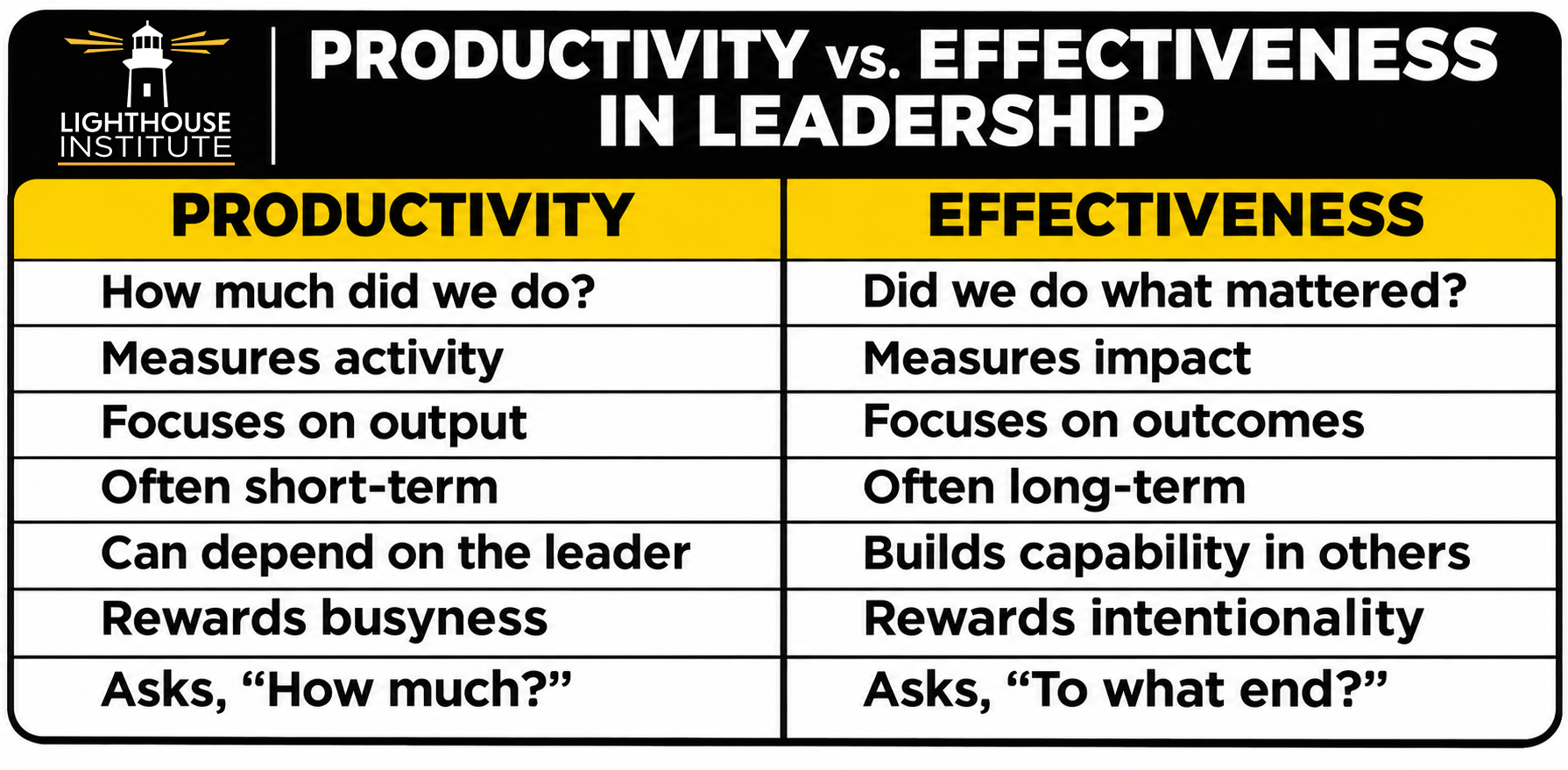
The Question Every Leader Should Ask
There is one question that brings all of this together:
“Is my leadership merely producing more work, or is it producing better outcomes, stronger people, and greater organizational capacity?”
Sometimes the productive thing is the easier thing.
Answer the email.
Solve the problem yourself.
Make the decision.
Move on.
The effective thing is often harder.
Coach the employee.
Confront the problem.
Clarify expectations.
Delegate authority.
Tolerate someone else’s learning curve.
Make the difficult strategic choice.
The irony of leadership is that doing more yourself can sometimes produce less from everyone else.
Effective leaders understand that their greatest contribution may not be what they personally accomplish. It may be what becomes possible in others because they led them well.
So I end where I began:
Leadership is measured by effectiveness, not by productivity.
Productivity tells us how much work was accomplished.
Effectiveness tells us whether our leadership produced the right results, developed the right people, and strengthened the organization for what comes next.
