
Within the Lighthouse Leadership curriculum, we talk often about mindset. We define mindset as a strongly held belief system that influences how we interpret events, make decisions, and behave. What deserves far more attention, however, is the foundation beneath mindset. Confidence, or more specifically: self-trust.
Confidence is not personality, bravado, or optimism. Confidence is earned self-trust, the belief that you can rely on yourself to respond effectively, even when outcomes are uncertain. Without self-trust, mindset collapses into positive thinking at best and self-deception at worst. With self-trust, mindset becomes a multiplier: driving consistent behavior, resilient performance, and long-term growth.
In leadership and in life, mindset determines behavior, behavior builds confidence (self-trust), and confidence strengthens mindset. This reinforcing loop is where real development occurs.
Confidence (Self-Trust) Shapes How You Interpret Reality
Mindset is not just about motivation. It is about interpretation. And interpretation is shaped by confidence, by how much you trust yourself.
James Clear, in Atomic Habits, reminds us that identity is built through behavior. “Every behavior gets a vote.” Each action either reinforces self-trust or undermines it. Over time, these votes accumulate into confidence or doubt, which then filters how we interpret everything that follows.
When something goes wrong, confidence determines the internal question:
- Is this feedback or failure?
- Is this an opportunity or a threat?
- Is this information, or is this about who I am?
Dr. Nate Zinsser, in The Confident Mind, is clear: confidence is not believing you will always succeed. Confidence is trusting that you can handle whatever happens next. That trust fundamentally changes mindset. Instead of spiraling into self-criticism, confident performers stay task-focused, solution-oriented, and grounded in realistic optimism.
When self-trust is strong, setbacks do not threaten identity. When self-trust is weak, even minor challenges feel personal. This is why confidence and mindset are inseparable: confidence stabilizes mindset, and mindset directs behavior.
A confident mindset is not emotional or loud. It is efficient. Self-trust reduces mental friction, allowing leaders to allocate energy toward execution, creativity, and decision-making rather than self-protection.
Self-Trust Makes Mindset Antifragile
Nassim Nicholas Taleb’s concept of antifragility describes systems that improve because of stress rather than merely surviving it. Human mindset works the same way, but only when supported by self-trust.
People with confidence do not try to eliminate stress. They engage challenges intentionally. They take intelligent risks. They expose themselves to volatility because they trust their ability to adapt. Their mindset is not, “How do I stay safe?” but, “How do I grow stronger from this?”
This is only possible because self-trust creates psychological safety. When you trust yourself, failure becomes information, not a verdict. That distinction protects identity and keeps mindset flexible rather than defensive.
Without confidence, stress narrows thinking and triggers avoidance. With confidence, stress becomes a catalyst. Self-trust allows mindset to grow stronger through challenge rather than collapse under it.
The Confidence & Mindset Feedback Loop
Confidence and mindset are not linear; they are reciprocal.
- Self-trust enables decisive action
- Action produces learning and evidence
- Evidence strengthens mindset
- A stronger mindset reinforces self-trust
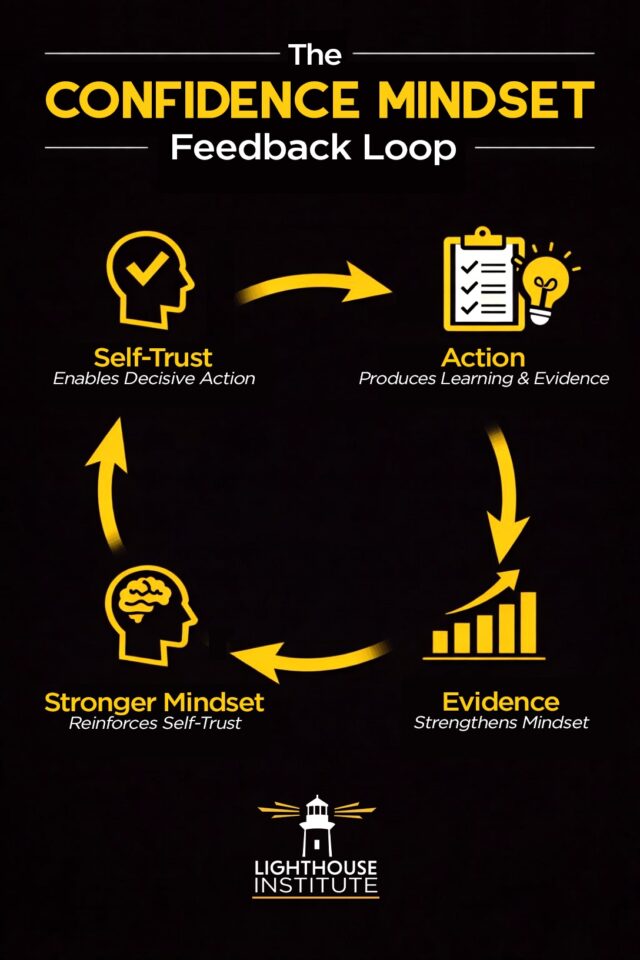
Over time, this loop compounds. Confidence built through preparation, follow-through, and honest reflection becomes durable because it is grounded in lived experience, not ego.
Conversely, we all experience the negative loop. As Positive Intelligence explains, the mind defaults to the inner Judge & saboteurs, the critics that erode confidence and distort mindset. Left unchecked, this loop creates hesitation, overthinking, and avoidance.
The work of leadership development, then, is not eliminating the inner critics, but intentionally reinforcing self-trust. Feeding the inner Sage through affirmations, recognition of progress, and small wins creates positive emotional reinforcement. Dopamine rewards consistency, and the subconscious begins aligning behavior with the confident identity being reinforced.
What you repeatedly trust about yourself becomes how you think.
How you think determines how you act.
How you act determines how confident you become.
How to Build Confidence (Self-Trust) Intentionally
Confidence is not something you wait for. It is something you practice through behavior.
Practical ways to strengthen self-trust include:
- Keeping small promises to yourself
- Affirming effort and consistency, not just outcomes
- Reflecting objectively, separating performance from identity
- Engaging discomfort on purpose rather than avoiding challenge
Each action reinforces the belief; I can rely on myself. That belief stabilizes mindset, accelerates learning, and improves performance under pressure.
Final Thought
Mindset is not just what you think. It is what you trust.
When you trust yourself, mindset becomes resilient, adaptive, and fast. You no longer require certainty, perfection, or constant motivation. You operate with quiet confidence: the assurance that whatever happens, you can respond, learn, and move forward.
That is not just a better mindset.
That is an antifragile one, built on self-trust.
Go Shine Bright ✨
