
A few weeks ago, I submitted a draft blog post and felt relieved that I was nearly finished. Then came the feedback.
There wasn’t much of me in it.
The article talked about mental, emotional, physical, and spiritual health; but it didn’t tell my story. I was attempting to communicate the importance of making time for each modality in order to show up as a better friend, wife, and mother. But showing up for others goes way deeper than taking care of my basic needs. I needed to peel back the layers and take a deeper, more personal look at my past and what shaped me. What were my experiences? Who am I today? And it occurred to me. Mindset plays such a pivotal role in who we are.
Then it dawned on me. If I was going to write about mindset, I needed to write about my own.
When I think about mindset, I don’t think about positive affirmations or motivational posters. Mindsets are STRONGLY HELD BELIEFS that IMPACT BEHAVIOR, which makes me think about the stories we tell ourselves.
Some of those stories are spoken aloud. Others become so deeply embedded that we don’t even realize they’re there.
I have had the privilege of reading several beautiful books over the last fifteen years. And one of the most impactful ideas I encountered in What Happened to You? by Oprah Winfrey and Dr. Bruce Perry is the shift from asking, “What’s wrong with you?” to asking, “What happened to you?”
That simple question changed how I viewed my own life.
The Stories We Inherit
When I was two years old, my father dropped my brother and me off at my mom’s work and walked out of our lives. As an adult, I understand there were circumstances, struggles, and limitations that had nothing to do with me. But a two-year-old doesn’t have that perspective.
Children are meaning-making machines.
I didn’t think, “My dad is struggling.”
I thought, “My dad left me.”
And somewhere deep inside, I began to believe that I wasn’t worth staying for.
Years later, those beliefs were reinforced during middle school.
Like many adolescents, I desperately wanted to belong. Instead, I found myself being teased, taunted, and made to feel different. Every comment, every joke, every exclusion seemed to confirm what I had already begun to believe about myself.
Maybe I’m not good enough.
Maybe there’s something wrong with me.
Maybe I don’t belong.
Looking back, I can see that middle school didn’t create those beliefs. It cemented them.
The thoughts continued as I entered high school. “If I get good grades… If I’m a good girl… If I’m pretty enough or skinny enough… my dad will come back.”
Then, when I was sixteen years old, my father and I had a chance to speak over the phone. The conversation lasted only moments, but the words stayed with me for years.
“I never wanted you. I don’t love you. I never want to speak to you again.”
At sixteen, I didn’t hear a broken man speaking from his own pain or limitations, or from his drug and alcohol abuse.
I heard proof.
Proof that the story I had been telling myself for years was true.
I wasn’t enough.
I wasn’t wanted.
I wasn’t lovable.
At least, that’s what I believed.
When Stress and Grief Shape Our Thinking
In Re:Stress, Chris Failla explains how we are meant to live with a little tension, a small gap that invites growth, challenge, and expansion. Stress inevitably impacts the way we think, interpret situations, and respond to challenges. But chronic stress narrows our perspective. It keeps us focused on survival rather than growth.
When we’re operating from survival, we aren’t asking, “What’s possible?”
We’re asking, “How do I protect myself?”
Looking back, I can see how many of my choices were rooted in self-protection rather than growth. What I didn’t realize at the time was that I was also carrying grief.
Before reading The Grief Recovery Handbook, I thought grief was only associated with death. I didn’t understand that grief could also come from unmet hopes, broken relationships, disappointments, and losses that never received acknowledgment.
I wasn’t just grieving the father I lost.
I was grieving the father I wished I’d had.
I was grieving the childhood experiences I never received.
I was grieving the belief that someday he would choose me.
Those losses quietly shaped my mindset for years.
The Beginning of Healing
My healing journey truly began when I participated in a Grief Recovery program. For the first time, I wasn’t simply talking about my experiences. I was actively working through them. As I moved through the process, something unexpected happened.
The story began to change.
Not the facts.
The facts remained exactly the same.
My father still left.
The bullying still happened.
The phone call still occurred.
But the meaning I attached to those events began to shift.
For years, I had viewed those experiences as evidence that I was the problem. Through the Grief Recovery process, I began to see something different.
I began to see my father as a human being with his own wounds, limitations, and unresolved pain.
His choices reflected him.
They did not define me.
For perhaps the first time in my life, I was able to separate who I was from what had happened to me.
That realization became the foundation for a new mindset.
Not one built on denial or toxic positivity.
One built on truth.
Rewriting the Story
Over time, mindset work became the process of identifying the stories I inherited and intentionally replacing them with stories that were more truthful, compassionate, and empowering.
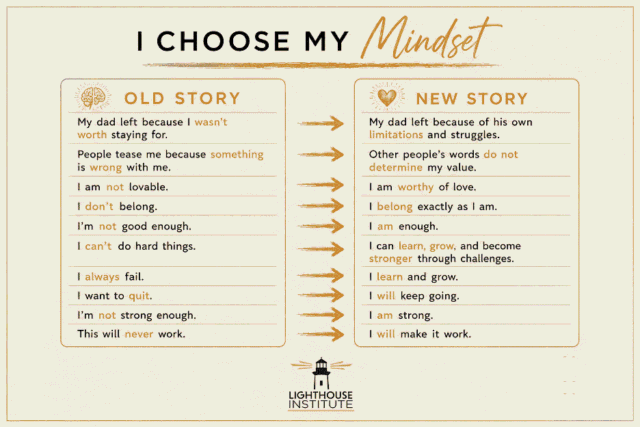
Below is a simple visual we share during our leadership series comparing fixed mindset (old story) vs. growth mindset (new story):
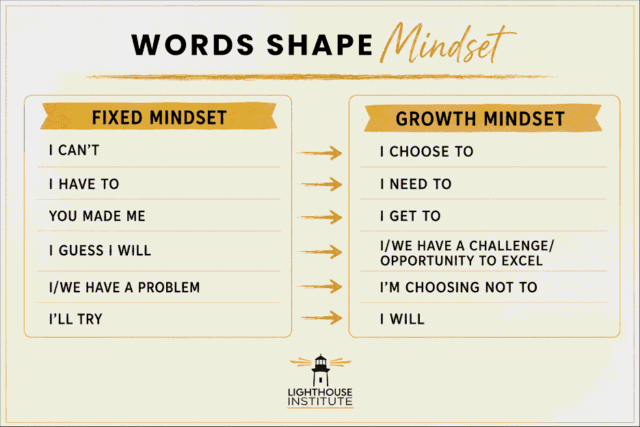
Henry Ford famously said,
“Whether you think you can, or you think you can’t—you’re right.”
For much of my life, I unknowingly proved the second half of that quote true. I believed I wasn’t enough. I believed I wasn’t capable. I believed I wasn’t worthy. And those beliefs influenced the way I showed up in the world.
As I began healing, I slowly started proving the first half of the quote true instead.
How Mindset Changed the Way I Show Up
One of the biggest misconceptions about mindset is that it’s about thinking positively all the time. For me, mindset isn’t about pretending something isn’t hard. It’s about choosing what voice gets the microphone when things get hard.
For years, the loudest voice in my head was the one that told me I wasn’t enough.
As I worked through my grief and began understanding how my past experiences had shaped my beliefs, I started challenging those thoughts. I learned that just because a thought enters my mind doesn’t mean it deserves my attention.
Over time, I developed a different internal dialogue.
When something is difficult, I no longer tell myself, “I can’t do this.”
I tell myself, “I’ve done hard things before and I WILL get through this.”
When I fail, I don’t tell myself, “Maybe I’m not good enough.”
I tell myself, “Try again. You’ve got this.”
When I’m tired, I don’t focus on how much further I have to go.
I focus on taking the next step.
This mindset has changed the way I show up in every area of my life.
It has changed the way I show up for my husband.
It has changed the way I show up for myself.
And perhaps most importantly, it has changed the way I show up for our three daughters.
Several years after I finished the Grief Recovery program, I began participating in strength and conditioning classes. People would often ask me how I kept going when the workouts became difficult. The truth is I don’t believe physical strength is what keeps me moving.
I believe it’s mental strength.
When my body wants to quit, I don’t allow myself to dwell on thoughts like, “This is too hard,” or “I can’t do this.”
Instead, I tell myself:
I am strong.
I am capable.
I can do hard things.
I will finish.
The workout eventually ends, but the lesson remains.
What we repeatedly tell ourselves becomes what we believe.
And what we believe influences how we act.
Today, those are the lessons we are intentionally passing on to our daughters. When one of my daughters steps into the batter’s box during a softball game, we don’t want her thinking, “I hope I don’t strike out.”
We want her thinking, “I’m a hitter.”
When our other daughter steps onto the pitcher’s mound, we don’t want her focused on the possibility of failure.
We want her thinking, “I thrive under pressure. I love this.”
Not because success is guaranteed. But because confidence grows from the stories we tell ourselves. Every challenge becomes an opportunity to reinforce a belief.
You can do hard things.
You can recover from failure.
You can learn.
You can grow.
You are capable.
Those are the stories I wish I had learned earlier in life. Now, they are the stories we are working to pass on.
Reflection
My childhood experiences shaped me.
My grief shaped me.
My stress shaped me.
But they don’t get the final word.
Today, when I look at my husband, my daughters, and the life we’ve built together, I realize mindset isn’t simply about changing how we think.
It’s about changing what we believe is possible.
For years, I believed I wasn’t enough.
Today, I know a different truth.
I am more than enough AND I am worthy of love. (A HUGE thank you to my amazing husband for constantly reminding me of this).
And perhaps the greatest gift of all is being able to help my daughters believe those things about themselves, too.
As you reflect on your own mindset, consider these questions:
- Where are the biggest opportunities to shift your language?
- What story about yourself have you been carrying for years that may no longer be true?
- If someone listened to your self-talk for a week, what would they learn about what you believe is possible for yourself?
The stories we tell ourselves matter.
The good news is that they can be rewritten.
