
Trust is one of the most overused words in leadership and one of the least examined. We talk about building trust, earning trust, and losing trust. But rarely do we pause to examine how trust is actually applied in practice.
The “three lenses of trust” illustration – Trust Earned, Trust Withheld, and Trust Extended – offers a powerful framework for leaders who want to build stronger organizations.
Let’s explore each lens and what it means for business leadership.
Lens One: Trust Earned
In the first illustration, a man applies for a loan. He has a solid job and strong credit history. The lender evaluates his track record and offers him a competitive loan. The trust extended to him is based on demonstrated credibility and character.
This is trust earned.
The lender takes on minimal risk because the applicant’s history suggests reliability. His past behavior predicts future performance.
In Business Leadership
Most organizations operate primarily through this lens.
- High performers receive more autonomy.
- Reliable employees get promoted.
- Proven vendors earn larger contracts.
- Teams that deliver get expanded budgets.
Trust earned is merit-based. It rewards consistency and results.
This lens is essential. Without it, accountability collapses. Performance matters.
But there is a limitation: trust earned is backward-looking. It depends on past data and leadership requires more than managing what has already been proven.
Lens Two: Trust Withheld
In the second illustration, the same qualified applicant is denied the loan, not because of his track record, but because of a blanket policy regarding age. The lender avoids risk by applying a general rule that overrides individual merit.
The applicant is trustworthy. The loan is denied anyway.
This is trust withheld.
Here, the decision is driven by fear, policy rigidity, or risk aversion rather than individual evaluation.
In Business Leadership
Trust withheld often shows up in subtle ways:
- “We don’t promote people without 10 years of experience.”
- “Remote employees can’t handle major accounts.”
- “New hires shouldn’t lead projects.”
- “That department always misses deadlines.”
In these cases, leaders make group-based judgments rather than individual assessments.
Trust withheld creates hidden costs:
- Talent disengagement
- Reduced innovation
- Cultural stagnation
- Loss of high performers who feel unseen
When leaders default to withholding trust, they may believe they are reducing risk. In reality, they are often increasing long-term organizational risk by suppressing potential.
Lens Three: Trust Extended
In the third illustration, the applicant has a bankruptcy on his record. His credit score is damaged. Many lenders have already denied him. But one lender looks deeper. They consider the totality of circumstances and determine he is more likely than not to repay the loan.
The interest rate may be higher. The risk is real.
Yet the lender approves the loan.
This is trust extended.
Trust extended is not blind trust. It is informed risk-taking. It looks beyond surface metrics and evaluates character, growth, and trajectory.
In Business Leadership
This is where transformational leadership lives.
Trust extended looks like:
- Giving a struggling employee a second chance after coaching.
- Promoting someone with high potential but limited experience.
- Empowering a recovering team after failure.
- Investing in talent others have overlooked.
- Delegating meaningful responsibility before someone “fully qualifies.”
Trust extended says:
“I see more in you than your metrics suggest.”
It accepts risk – but does so thoughtfully.
And here is the paradox: trust extended often creates the very performance it hopes for.
When leaders extend trust:
- People rise to the expectation.
- Loyalty deepens.
- Ownership increases.
- Culture strengthens.
Trust extended builds future performance, not just rewards past performance.
The Key Differences Between the Three Lenses
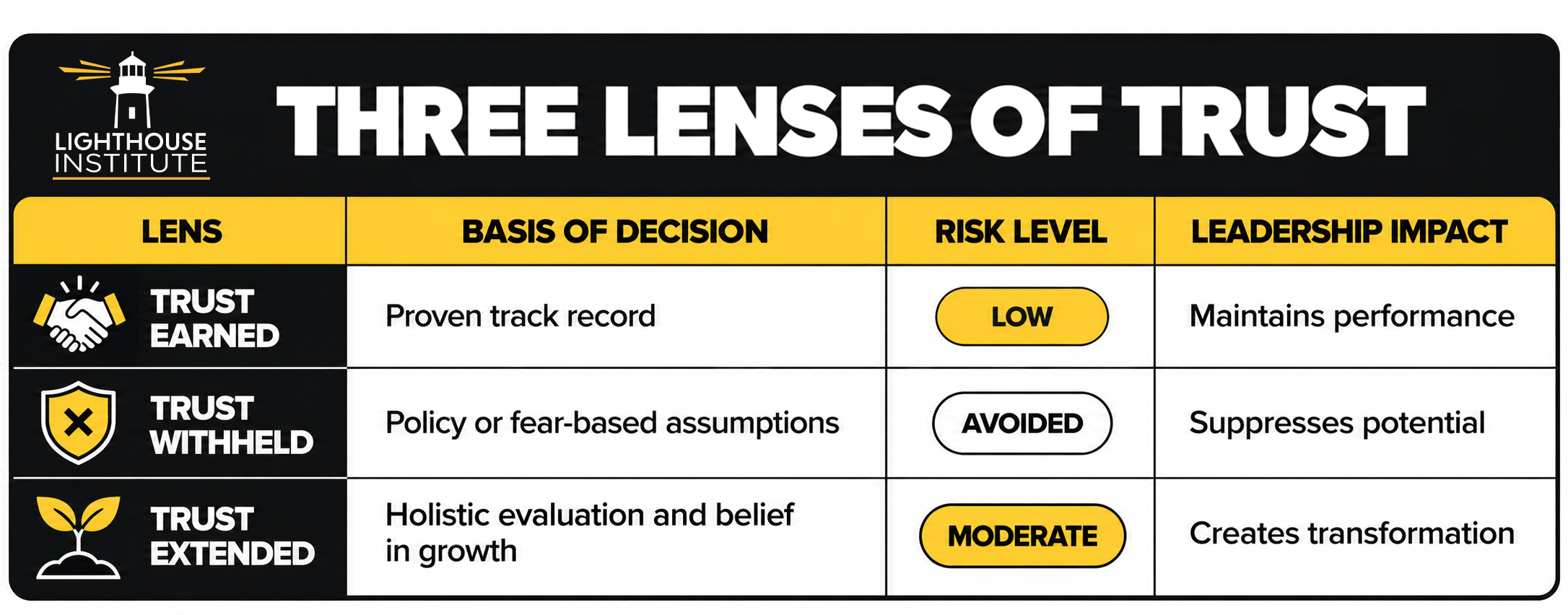
The most important distinction is this:
- Trust earned rewards the past.
- Trust withheld protects the present.
- Trust extended builds the future.
Applying the Three Lenses to Your Leadership Practice
Effective leaders know when to use each lens.
1. Use Trust Earned to Maintain Standards
Accountability matters. Results matter. Track records matter. Organizations cannot function without them.
2. Guard Against Trust Withheld
Examine your policies and assumptions:
- Are you judging individuals or categories?
- Are you avoiding risk at the expense of growth?
- Are high-potential employees leaving because they feel capped?
Fear-based leadership quietly erodes culture.
3. Intentionally Practice Trust Extended
Ask:
- Who deserves a second look?
- Who has grown beyond their past mistake?
- Who is ready – even if their résumé says otherwise?
- Where am I over-indexing on metrics instead of trajectory?
Trust extended should not be reckless. It should be thoughtful, measured, and supported.
Without it, leadership becomes management – and management rarely transforms organizations.
The Leadership Choice
Every leadership decision filters through one of these three lenses.
The strongest cultures are built by leaders who:
- Maintain standards (Trust Earned),
- Avoid bias and rigidity (Trust Withheld),
- And courageously develop people (Trust Extended).
If you want a predictable organization, rely only on trust earned.
If you want a safe organization, withhold trust broadly.
But if you want a growing, resilient, high-performing organization – you must learn to extend trust wisely.
Because in the end, great leadership is not just about evaluating who people have been.
It’s about seeing who they can become.
